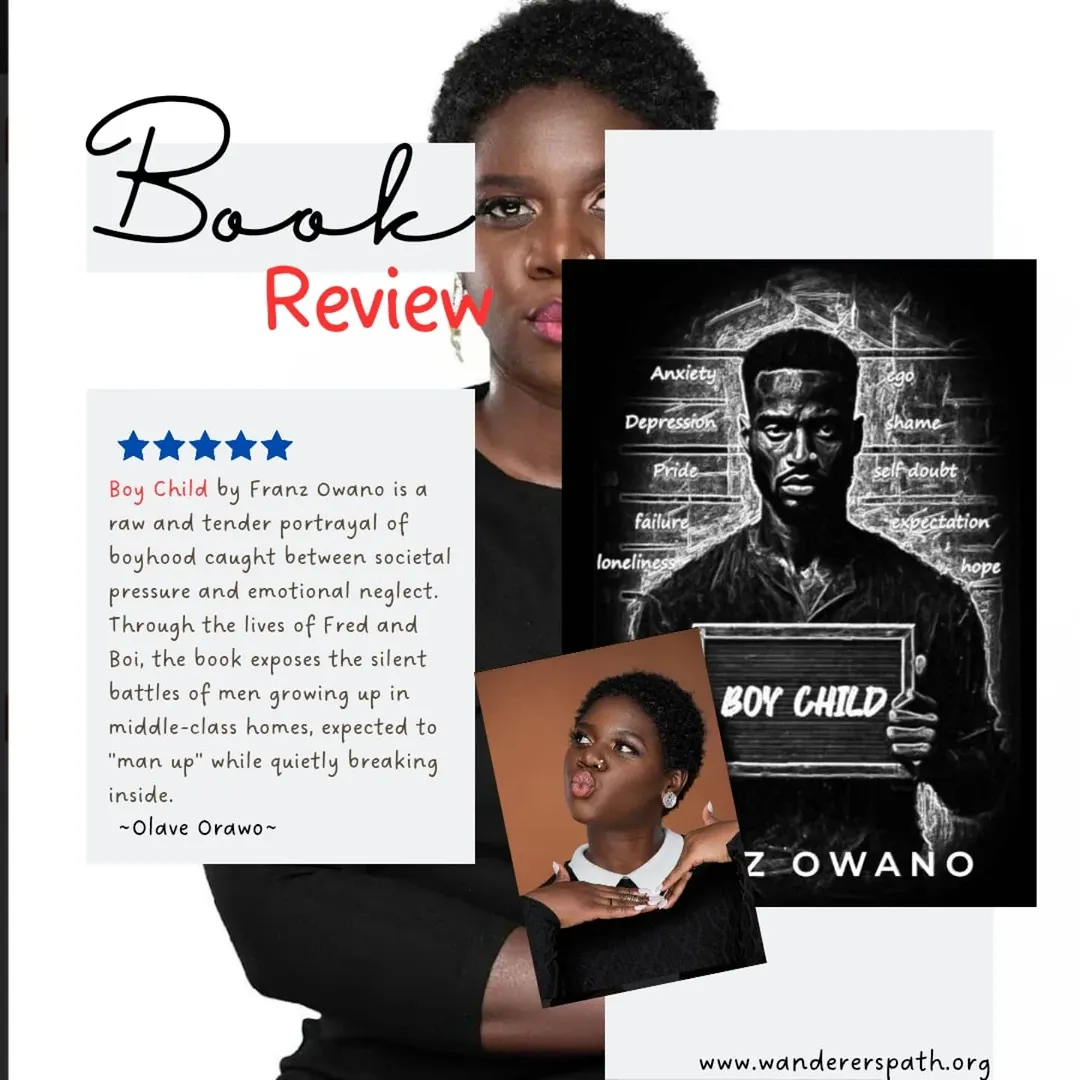

Reading Franz Owano’s Boy Child coincided with my transition into Emotional Intelligence Coaching — particularly, trying to figure out how to package my offerings for the brotherhood. As a loud and proud advocate for women’s empowerment, I often find myself quietly worried about the exclusion of men. My stance remains: our biggest undoing was empowering the girl-child while forgetting to help the boy-child transition too. I mostly ponder this in silence (lest I be labelled a "pick me" — LoL!), and that worry is especially inspired by the love and fierce protection I feel for my four nephews, now aged 20, 9, 4 and 2.
It probably also has something to do with having a father in his twilight years who is simply the best dad anyone could ask for. I think often about how I can help him experience softness. That man has been nothing but an anchor, a fortress. I first saw my dad take painkillers when I was 20 — it only hit me then that he, too, is mortal, capable of illness and flaws.
My eyes are wet — yet I am my father’s daughter. We shall do no such thing as cry… Hahaha. Let us!
My first impression of Boy Child? "WoW! I literally get to see the world through the eyes of a man."
My friends can confirm how I wouldn’t shut up about it. At first, I thought girls should read it — to help manage the delusions we sometimes have about what the men in our lives are thinking. But as I sat with the book’s depth and considered its significance for boys and men, especially those around my age, I was blown away.
Franz’s ability to paint the characters’ earlier lives and keenly trace their transition into adulthood — revealing who and what shapes their thinking — is gold for young boys. Imagine a boy in his formative years being able to name abuse, even subtle forms and learning that some things really aren’t his fault. That's a solid foundation for emotional balance.
We see emotional neglect clearly displayed in Nathan’s treatment of Fred — a self-centred man convinced that provision alone is love. The puppet show Nathan runs — crumbling then withholding financial support — is textbook financial abuse.
Then there are the ghosts that haunt Ajenda and Boi — this constant inner nag that they must not turn out like their fathers. Men they consider failures even on a faulty scale. Comparing them to their dads is enough to offend. Trauma gives us two options: become what we loathe or work every bone in our body not to. All three characters, in my view, would make men today (especially those my age) FEEL SEEN.
Now that the loneliness pandemic is sweeping men off the planet (quite literally), it’s vital that they find community and feel understood. This book does exactly that. It gives my brothers something sacred: a mirror.
Standout Themes in Boy Child by Franz Owano
Middle-Class Identity Crisis
Boi and Fred’s social class narrative is rarely told. Kids who grow up seemingly well-off but carry a scarcity mindset. Nathan, Fred’s father, has means, yet pushes Fred to humiliating levels of begging just to offer something as basic as food. He’s controlling, god-playing — possibly even competing with his son. The resentment runs deeper every time Fred doesn’t catch a cold when he coughs.
It’s a common middle-class dynamic — parents feeling like their kids haven’t suffered enough to deserve ease, and so the Freds of the world end up broke in their early adulthood, despite having a decent home life.
On the other hand, Boi is plagued by the Moirae of a mother. Shirleen scripts every detail of Boi’s life — including the decision to send him abroad to study, a move that has often proven futile. Even Kim Jong-il couldn't control the outcome of this strategy.
African households know this script well, especially with mothers and sons. Boi’s mother, too, meddles in his life to the extent that his girlfriend’s actions seem guided by her. It left a bad taste — bordering on emotional incest. Shirleen may be subconsciously trying to mold Boi into the man his father Christopher wasn’t.
These stories unveil the identity crisis of the middle class — posing as affluent while denying their children the autonomy that’s often a hallmark of truly wealthy families.
Poverty is Dehumanizing
Then we meet Ajenda — born into poverty. Morality doesn’t exist in his dictionary. Near-death experiences, the pull toward crime to support family — all these strip a man of dignity. When criminals look out for you more than society does, survival trumps ethics.
Ajenda’s legal practice is ruthless. Money is the only god. He’s so terrified of lack that he can’t downscale during a rough patch, even as he slides into debt with a crook, bills unpaid, creditors threatening his family. Dodging landlords becomes a family sport.
Dysfunctional Romantic Attachment
The book gives a vivid, nuanced look at men’s fear of commitment — sometimes a trauma response. Fred, for example, only walks away from relationships once they edge toward commitment. Yet, he’s not one to abandon responsibility. You can sense his chronic fear of turning into his father — unable to provide, failing his child.
Ciku insisting on having his child even after he clearly states he isn’t ready? I was p*ssssed!
Ajenda’s marriage to Yvette? Pure business. I struggle to see him as capable of love. Multiple infidelities, manipulative streaks — I respect his hustle, but liking him? No thanks. Maybe I relate too much to Paula (Yvette’s sister), and Ajenda’s intense dislike for her seals the deal. I took it personally (LoL!).
Then there’s Boi — King of nonchalance. He just slips into relationships he didn’t initiate and doesn’t have the guts to end them. Enduring the circus Paula and his mom put on until she breaks up with him? Legendary passivity.
Spineless Behaviour (Lack of Accountability)
This brings me to my next point: can someone point me to one backbone in this book? It was painful watching three grown men have their lives dictated for them. If this were a play, it’d be a muppet show.
I wanted Fred to spit in Nathan’s face (okay, not literally — but still!). I wanted him to quit med school, cut off his dad, vanish from his life. I wanted him to live independently — hustle, struggle, but be free.
What did Boi even study in Canada? Why couldn’t he get a job anywhere but his family company? Why not rent a place in the outskirts of Nairobi instead of staying put under parental control? My mother discussing my affairs with my girlfriend, docking my salary, taking the car — and I still stick around? Please.
Ajenda, for all his issues, at least had a spine. A crooked one, but a spine nonetheless. In a tornado, would you rather hold the pole or the flag? Exactly.
Mental Health and Community
The modern shift hasn’t been smooth. Men are still held to outdated standards while also expected to navigate new norms. This glitch might be why we’re losing so many young men to suicide. I’d add femicide here, but today we only speak for men.
Mental wellness still feels too “feminine,” and men are slow to claim space in it. In Boy Child, these men don’t really have support systems. They meet at a bar, drink, throw jabs at each other, and go home numb. That’s all the “therapy” they get.
Each of them lives in denial. Boi’s brain must be a battlefield, having taken literal bullets for his family while constantly being compared to the father he despises.
This is a book for men, so I’ll hold back on commenting about Yvette constantly forgiving Ajenda’s infidelity.
Even in my own field, I know the challenge of creating emotional regulation tools that men will actually use. Maybe the solution starts with enlightened men creating spaces for each other — while cautiously avoiding that red pill line.
Other Things I Loved
I found the delayed convergence technique quite exciting. I first came across it in Charles Chanchori’s No Humans Allowed and it just makes me happy for no specific reason ever since.
This is the first book since I was 16 that made me pause and Google words. The English isn’t exactly everyday, it’s the kind you have to sit with a bit and would favour those with strong vocabulary. I know we say Keep It Simple, but give me more of this please(Haha).
I’m curious to know what Franz’s IQ score is… the author is clearly brilliant. He displays impressive intellectual range, incorporating terminology and references from medicine, law and philosophy throughout the narrative. I can't personally verify the accuracy of the medical and legal references, but it definitely doesn’t come off as fake(LoL).
As a passive learner, I really enjoyed the philosophical arguments. They were the kind of thought detours that made me pause and reflect. Honestly, if school textbooks were written like this, I might’ve actually liked school.
______________________________________________________________________________
As is signature of all Kenyan writers I have read so far, Franz upholds culture… there isn’t a happy ending in sight. *Sobs as light dims - End Of Scene-
After all is said (and not done — I’m lazy), Boy Child by Franz Owano is a GEM. A timely theme, a valuable addition to literature and officially one of my favourite storytelling companions.