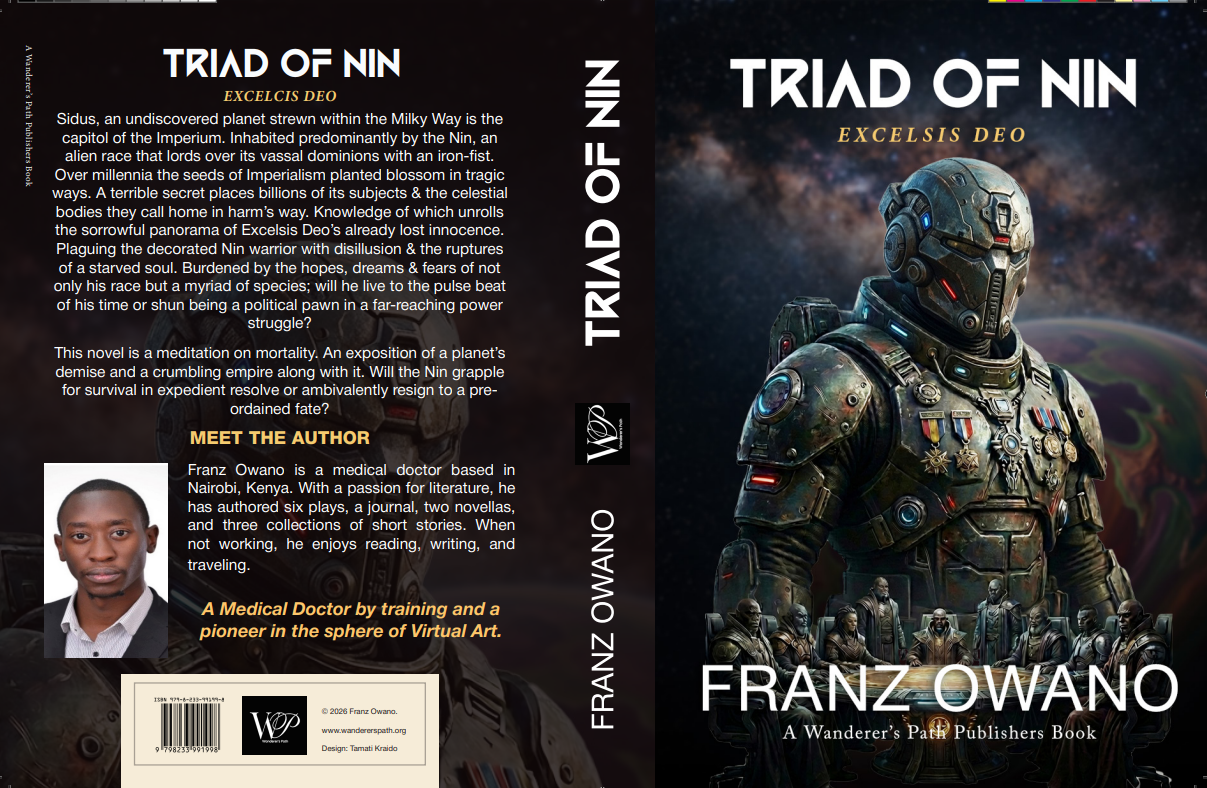

Stories of witchcraft and ghosts to a city dweller are the equivalent of stories of extraterrestrial life to a village girl. Both seemingly exist, but provide such flimsy evidence that only those who know… know. That would simply explain why Triad of Nin would be my first-ever interaction with the world of aliens at the tender age of 33.
Fascination would be an understatement in reference to this book. Again, as is signature to his writing, Franz prescribes an almost psychedelic trance by thoroughly abusing the “story within a story within a story” technique. I am actually not complaining. It is exhilarating, travelling through millenniums to unearth the root of present-day love and hate.
I also need this in moving picture form, and I would personally like to be assigned the role of a fly on the wall in the set costume design team—because, child! As usual, I could fan out to eternity… so let’s get into the standout themes.
The Creation Story / Theism
Though stuffed towards the end of the book, I love me a good peek into where it all began. Franz is kind enough, at the very beginning, to give us mere humans a visual illustration of each of the interplanetary species: Nin, Jovian, Titrian, Zandorian, and Cerean. For a good portion of the story, we only know what they look like. Tucked away in a story within a story, we learn why their features are what they are.
Spoiler alert: the “becoming” of their features alludes more to creation than evolution, thus setting the stage for a theistic society—even with life spans of up to 500 human years. We experience a mixture of what, in human life, I would equate to Abrahamic religion and African spirituality.
This is clearly depicted through Publius Maro’s last moments, as he pleads with the callous traveller (grim reaper) for more time, while also asking his father and grandmother to intercede on his behalf. His fear of whether life is any better on the other side gives us a glimpse into belief in an afterlife, no matter how subtle.
There’s a level of comfort that comes from the hope that this isn’t final—and that there are powers far more powerful beyond.
The X Chromosome Supremacy
Even on Mars, girls still rule. Women have been painted as scheming little snakes who weaponize their beauty—hypnotizing with whatever femininity portions they brew in the middle of the night.
Isn’t the Imperata Publius Maro, incumbent from Randal Maro, wielding power over five planets because a woman in his lineage schemed to the high heavens and back?
Duchess Mae Maro struck the Virgin Queen’s memory for me. In case you are lost, that would be Queen Elizabeth I of England, who used the prospect of marriage as a strong negotiation tool. Speaking as an Emotional Intelligence specialist, Mae Maro’s ability to calculate the probability of future events playing in her favour—and, in time, sacrificing that which won’t—is highly impressive.
There’s more of them. Lady Zehra makes a conscious move to marry a pathetic Nin to save her family from the hole her father has dug them into, while also later learning that her mother-in-law, Lady Sega Gayo, only met her husband three minutes before marrying him. Okay… no more spoilers.
Sacrifices would include innocent lives at some point, but the end goal remained crystal clear in all her angles. Mae Maro struck just the right balance of friendship to earn trust in different camps—even those waging war against each other. Rising from a widow stripped of everything, left only with the clothes on her back.
She was definitely a powerful subject in the making of dynasties to come, but was first lifted—and then supported—by her kind. Rosalind Bon, who already sat in the Council of Nin as an overseer, was her footstool. Through it all, her mother-in-law Adelide, even at times in disagreement with her moves, remained a constant support and tight-lipped around anyone who could compromise Mae.
She built and set up her son—and by placebo, her grandson. But as the old saying goes…
Strong Men Raise Weak Men
The overlords, Randal and Publius Maro, ran a tight ship. Each had their own flaws, as is with every creation, but the Nin remained supreme. They managed upheavals and wars. They preserved the sanctity of the imperium. But as we all know by now… it be your own people.
We see a careless Thorn Princepus, heir of the Prima Imperata, who could actually be said to have some fascination with war. In comes his son; weak, indisciplined, indulgent, entitled… overall, just disgusting.
In a desperate move to curb any “oopsies” that might cost the imperium too much, Publius and Lady Sega Gayo end up playing housekeeper, constantly cleaning up after Thorn and basically “childproofing” a galaxy.
Still, in anticipation of disappointment, Publius is not ready to let caution fly to the wind. The future of the intergalaxies cannot be trusted to a grown boy who can’t even keep his third member to himself.
So, he creates his own child… who is actually raised by a peaceful Titrian monk, but grows to seek indefinite mental and physical fortitude. I won’t say how Publius does this, because I think I have spoiled enough.
Now, down to the true nature of existence…
The Price of Power
Just so you know… they are actually on their way to invade Earth. I don’t know if Elon Musk intends to meet them halfway. Anyway…
We see that politics will always exist, no matter the species. And politics should run a branding masterclass, because it maintains its primary model of being murky and bloody.
We experience major capitalist themes in Triad of Nin. Unchallenged servitude, my nice way of saying slavery. Elitist behaviour, we see how Jovians, who indulge mostly in merry-making and don’t invest in being “proper,” are considered barbaric.
We experience an uprising of clones, of course met by full-force retaliation. The Titrians also almost seem to live in constant fear, as history punished them for only being a safe haven for refugees.
Then there’s the invasion and what I’d equate to colonization of Cerea. Cerean blood consists of molten gold and sapphire crystals. Does that remind you of any continent? The cradle of mankind, maybe? No?
Conclusion?
This is, by far, the toughest book I have ever had to review. There’s so much that goes on with every turn of a page, and I feel only a spirited discussion by those who’ve read it too would quench the desire to fully articulate how brilliant this piece of sci-fi literature is.
We even get a glimpse of teleportation (screams chaotically), the inner workings of martial arts, the science of gravity and space travel. Whew!
However, being a kinesthetic learner, I struggled to imagine scenes in this book, since I could not paint what my eyes have never seen. So I am really eager to know what the visuals look like from a proper sci-fi enthusiast’s imagination.
My review does Triad of Nin no justice. It is limited to what my human experience is…yet the book is everything but human.